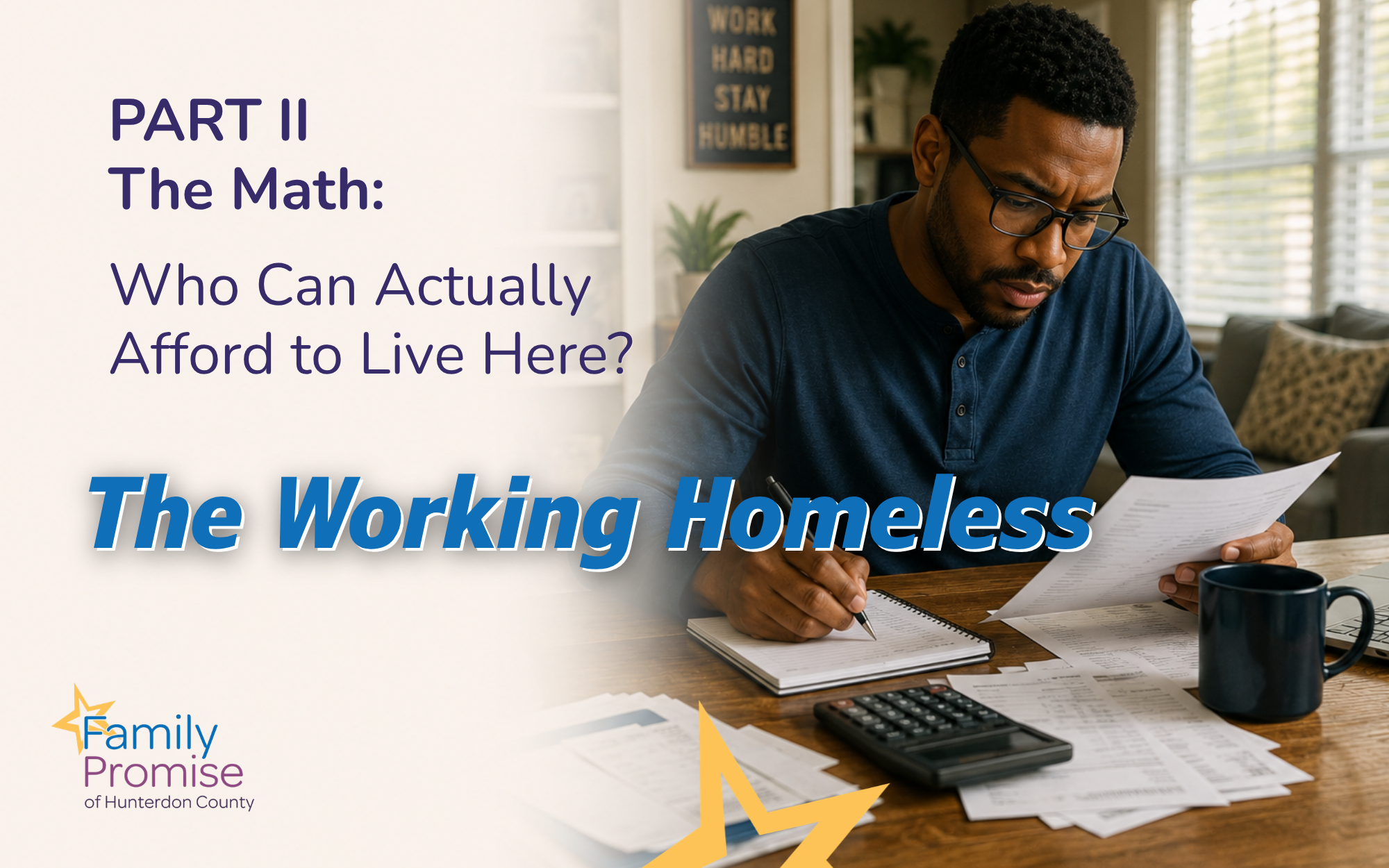
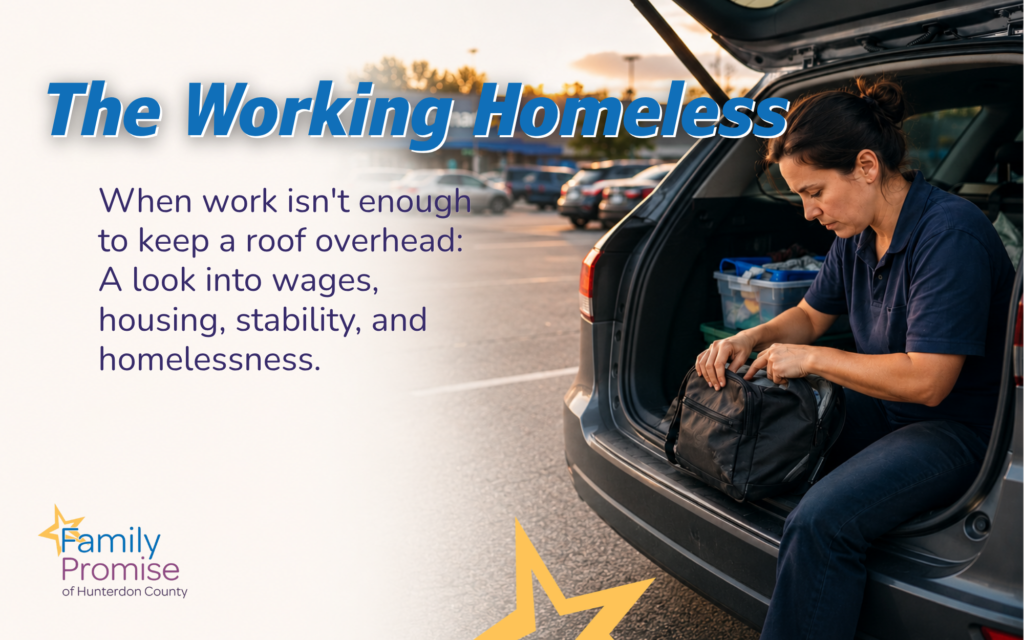
The Working Homeless – The people who work, contribute, raise families… and still find themselves without a place to call home.
With Labor Day approaching on Monday, September 7, we’ve been thinking about “work” in the context of what we see every day in our work with individuals and families experiencing housing instability.
As we anticipate a holiday meant to recognize the contributions of American workers, we’re taking a closer look at something we see in the real lives of the people we serve and asking what the research can tell us about it. What happens when someone is working, earning a paycheck, and still can’t keep a roof over their head?
PART I – The Myth: “Just Get a Job.” What if the person you think needs a job already has one?
Every year, Labor Day arrives with the familiar rituals of late summer: one last barbecue, one last trip to the beach, one last long weekend before school, schedules and routines take over again. But Labor Day has a deeper meaning. It is a holiday born from the American labor movement and from generations of workers who fought for better wages, safer working conditions, reasonable hours and the basic proposition that the people who work deserve dignity.
So as Labor Day approaches, we want to ask a question that sits directly at the intersection of work and the work we do every day at Family Promise of Hunterdon County: What happens when someone is working… and still becomes homeless?
It is a question worth asking because many of us carry a very simple picture of homelessness in our heads… Someone doesn’t have a job. They don’t have money. They can’t pay rent. They lose their home. They become homeless. No job → no money → no housing → homelessness.
It’s a tidy sequence. It is also incomplete. And if we are serious about understanding homelessness, and about solving it, we have to be willing to let go of explanations that are comforting simply because they are simple… because the research tells us something that may challenge what we think we know.
Some people experiencing homelessness are working. Not hypothetically. Not occasionally. Not because someone at a nonprofit is trying to make a point. The data says so.
Some Numbers That Should Make Us Stop
In 2021, researchers at the University of Chicago published an unusually comprehensive examination of the economic circumstances of people experiencing homelessness in the United States. The researchers, led by economist Bruce Meyer, did something important. Rather than relying solely on traditional surveys, they linked information about people experiencing homelessness with administrative records, including tax and government-benefit data. This allowed them to examine employment, earnings and economic circumstances in a way that had rarely been possible before. And one finding should stop us in our tracks: 53%. Approximately 53% of adults under age 65 experiencing sheltered homelessness had formal labor-market earnings during the year they were observed as homeless. And then there is this: 40%. Approximately 40% of adults under age 65 experiencing unsheltered homelessness had formal employment during that same year.
The Urban Institute subsequently highlighted those findings in an article asking a deceptively simple question: Why is it so hard for people experiencing homelessness to “just go get a job”? The numbers simply do not support the cartoon version of homelessness in which the central problem is simply that nobody wants to work. They point to something much more complicated and closer to the reality encountered by homeless-service providers every day.
The Myth of the “Homeless Person”
Part of the problem may be the phrase itself: “Homeless person.” Those two words can make homelessness sound like an identity… a type of person someone IS rather than a condition someone is experiencing. We don’t usually say “the unemployed person” when someone loses a job temporarily. We don’t say “the eviction person” when someone is forced from an apartment. We don’t say “the cancer person” when someone is diagnosed with cancer. Yet somehow, “homeless person” can become a category in the public imagination that carries an entire collection of assumptions with it: Maybe they are unemployed… uneducated. Maybe they don’t want to work. Maybe they have addiction issues… or severe mental illness. Maybe they made bad choices… or they don’t know how to manage money. Maybe they simply don’t care.
While some people experiencing homelessness do struggle with mental illness, substance use, have disabilities, have experienced incarceration, domestic violence, trauma or profound personal loss… those realities deserve compassion and effective services – not denial.
But there is a crucial distinction between saying that these issues can be associated with homelessness and saying they are the universal explanation for homelessness. They are not. The United States Interagency Council on Homelessness explicitly cautions against the idea that most people experiencing homelessness have a substance-use or mental-health disorder. USICH notes that while rates of these conditions are elevated among people experiencing homelessness, the majority of people experiencing homelessness do not have a severe mental-health or substance-use issue and the large majority of Americans who do have those conditions never experience homelessness.
Why does this distinction matter? Because if we decide that homelessness is fundamentally caused by individual pathology, we start looking for ways to fix the individual. If we understand homelessness as something that can happen when people with very limited resources encounter a severe shortage of affordable housing, we start asking a different set of questions. Questions about wages… housing… transportation… childcare… healthcare… eviction… employment. And what happens when one relatively small disruption hits a household that has no financial cushion.
“But If They Can Work, Why Don’t They Just Get Housing?”
This is where the conversation may get uncomfortable. Employment is important. Of course it is! A job can provide income, purpose, routine, connection and a pathway toward greater economic stability.
At Family Promise of Hunterdon County, we want people to be employed when they can work. We want families to have opportunities. We want people to build income and independence. But a job and a home are not the same thing. Employment does not automatically produce enough income to afford housing. And having an income does not automatically mean having enough income… a distinction that is absolutely central to understanding working homelessness.
The Urban Institute notes that even when people experiencing homelessness are employed, their incomes may still be insufficient to afford housing in markets where affordable units are in short supply. The National Alliance to End Homelessness makes the same point: many people experiencing homelessness work, but employment alone does not guarantee housing because wages may not be high enough to cover housing costs. In other words: “Get a job” and “get housed” are not interchangeable instructions. A person can accomplish the first and still be unable to accomplish the second.
Let’s Talk About the Word “Poor”
There is another problem with the way we talk about this. We have become accustomed to the phrase “Working Poor.” Unfortunately, we have become so accustomed to that phrase that makes it almost meaningless. Someone says: “She’s working, but she’s poor.” and the response can be: “Well, lots of people work and aren’t rich.” Conversation over.
There is something almost numbingly familiar about poverty when it remains abstract. A person working two jobs but struggling to pay bills – is sad. A family choosing between groceries and a utility bill – is unfortunate. A parent unable to save anything because every dollar goes toward rent, food, childcare and transportation – is difficult. But then something happens: the rent increases… the car breaks down… the hours at work are cut… the child gets sick… the relationship ends… the paycheck is delayed… the landlord files an eviction action — And the family loses their home. Now the problem has crossed an invisible line. It is no longer simply poverty. It is homelessness. And now the community can see it.
The Parking Lot Changes Everything
Let’s imagine two families. Both of them have parents who work and are struggling financially and have very little savings. Both are spending most of their income on housing. The first family is still paying rent. They are exhausted, behind on bills and one emergency away from crisis. But they have an apartment. We don’t see them.
The second family falls behind, loses the apartment and begins sleeping in their vehicle. Now we see it… maybe in a parking lot. Now we see ‘a problem’. But the problem didn’t begin there. This is simply where the problem became visible. Homelessness is often treated as though it suddenly appears when someone loses a home. In reality, there can be a long period of financial instability before the actual loss of housing occurs.
The University of Chicago research suggests something even more profound: homelessness often exists within a much longer period of severe economic deprivation. The researchers found that incomes among people who experienced homelessness remained extremely low over the decade surrounding the observed episode of homelessness. Why this matters is because it challenges another common assumption: That homelessness is always the result of one dramatic event. Sometimes that may be the case, but often enough homelessness is what happens when people have been living without enough financial margin for a very long time… and eventually something gives.
The Difference Between Having a Job and Being Economically Secure
Employment is not the same thing as economic security. Someone can have a job and still have:
- no savings;
- no reliable transportation;
- unaffordable rent;
- overwhelming childcare costs;
- medical expenses;
- debt;
- unpredictable work hours;
- insufficient food;
- no emergency cushion;
- or nowhere to go if something goes wrong.
And when a household has no cushion, an ordinary disruption can become a housing crisis.
The United States Interagency Council on Homelessness describes modern homelessness as being driven by multiple interconnected factors, including shortages of affordable housing, wages that have failed to keep pace with housing costs, inadequate safety nets and barriers to healthcare and economic opportunity. USICH goes so far as to note that more than half of Americans live paycheck to paycheck and may be only one crisis away from homelessness. That does not mean everyone living paycheck to paycheck becomes homeless. It means financial vulnerability matters. And the thinner the margin between income and basic expenses, the less room there is for life to go wrong.
“But What About Drugs? What About Mental Illness?”
These questions come up almost every time homelessness is discussed and they deserve honest answers. Yes, substance-use disorders and serious mental-health conditions are present among some people experiencing homelessness. And yes, those conditions can make obtaining and maintaining housing more difficult. We all agree that people experiencing homelessness need access to mental-health care, substance-use treatment, healthcare and other supportive services, right? But we should be extremely careful about turning “some people experience this” into “this explains homelessness.”
The federal government’s own research does not support that simplistic conclusion. USICH reports that the majority of people experiencing homelessness do not have a severe mental-health or substance-use disorder. And research from the 2021–2022 California Statewide Study of People Experiencing Homelessness provides another striking example. In that study, only 4% of respondents identified their own substance use as the reason they left their last housing, while 12% identified lost or reduced income. An overwhelming 89% reported that they struggled to obtain housing or exit homelessness because they could not afford housing. That does not erase addiction or mental illness. It puts those issues in proportion… which matters when we are trying to solve a problem.
What About Education?
There is another stereotype worth examining: that people experiencing homelessness simply lack the education or skills necessary to support themselves. Again, reality is more complicated.
People experiencing homelessness are not a single demographic. They are individuals, families, veterans, parents, young adults, older adults, people with disabilities, people who have spent decades working. They are people who have never had the opportunity to build a stable career, people whose lives were disrupted by circumstances beyond their control, people who have made mistakes, people who have survived extraordinary circumstances. And they are people who, sometimes, are simply poor. The more we insist upon finding one personality defect that explains all homelessness, the less capable we become of seeing the actual people in front of us.
What We Might Be Missing & The Myth We Need to Drop
The most startling conclusion from the employment research isn’t actually the 53% or the 40%. It is what those numbers force us to ask next. If people can be working and still be homeless, then a job is not necessarily the finish line. It may be one piece of the solution… but it is not the whole story.
Our understanding of homelessness has to become more sophisticated. Instead of asking: “Why doesn’t this person just get a job?” we might ask: What kind of job? How much does it pay? Are the hours stable? Does the person have transportation? Can they get to work from where they are staying? Can they afford childcare? Can they afford the housing available in the community where they work? What happens if their car breaks down? What happens if their hours are cut? What happens if rent rises by $200 a month? What happens if they have no savings?
Those questions don’t excuse anyone from responsibility. They simply recognize that responsibility operates within circumstances. When we want people to succeed, we have to understand those circumstances.
Maybe the problem isn’t that Americans have been told to work. Work matters… it always has and will. The problem may be that we’ve sometimes treated “work” as though it automatically equals “stability.” Which it does not. A paycheck can be real and still be insufficient. A job can be real and still be precarious. A person can be employed and still be poor… they can be poor and still be working hard. A person can be working hard and still lose their home.
That last sentence is the one we need to sit with.
Once someone loses their housing, the stakes change dramatically. The person who was struggling to make rent is now trying to keep a job without a home. The parent who was trying to get their children through the school year is now trying to maintain stability without stable housing. The worker who was already stretched financially is now dealing with the additional costs and complications of homelessness. And the community that might once have viewed that family’s financial struggles as a private matter now has a visible housing crisis to address.
“Just Get a Job”
Perhaps it’s time to retire this phrase in the conversation of resolving homelessness. Not because work doesn’t matter, but because it matters too much to reduce it to a slogan. If we genuinely believe work should provide a pathway to stability, then we should be willing to ask whether the economy is producing enough jobs that actually make stability possible.
We should ask whether wages are keeping pace with housing and ask whether transportation connects people to employment. We should ask whether childcare makes employment possible and whether people can survive an unexpected expense without losing their homes. And we should ask why a person can sometimes do exactly what we tell them to do, they go to work… and still end up sleeping somewhere that was never intended to be a bedroom. That is not an argument against work. It is an argument for taking work seriously.
The 53% and 40% figures may just be statistics… but behind every percentage is a person. Someone, right now, is getting dressed for work in a shelter. Someone keeping a uniform clean when they don’t have a home or leaving their vehicle they sleep in early enough to make it to a shift on time. Someone trying to make a paycheck stretch across food, transportation and temporary lodging. At this very moment, statistics tell us that someone is answering a supervisor’s text while wondering where they will sleep that night. Someone is working while their children are experiencing housing instability alongside them. This “someone” may look perfectly ordinary to the person standing beside them in the grocery store, on the bus, in the parking lot or at work. Because the experience of homelessness does not necessarily announce itself… sometimes it looks like a person going to work.
This Is Where We Begin
This series is not going to argue that every person experiencing homelessness is employed. They aren’t. It isn’t going to argue that employment doesn’t matter. It does. It isn’t going to pretend that addiction, mental illness, disability, trauma or other personal circumstances never play a role. They can. Instead, we’re going to ask a bigger question:
What if homelessness is not simply about whether someone works… but about whether their work, housing, transportation and other basic necessities can actually fit together into a stable life?
Let’s start asking that question and change the conversation and the picture of homelessness. It is no longer simply: No job → no money → no home. Sometimes it is: Job → paycheck → rent → rising costs → no financial cushion → one disruption → housing loss → homelessness.
And if that is possible… if a person can be working and still lose their home then perhaps homelessness isn’t just a story about people who have failed to work. Maybe it is also a story about what happens when work stops being enough. That is a story worth investigating.
And as Labor Day approaches, we’re going to keep asking questions and as “Hunterdon Promises…”, we will work together to find the solutions
- Employment alone isn’t enough to solve homelessness, study suggests | University of Chicago News
- Homelessness Data & Trends | United States Interagency Council on Homelessness
- Federal Resources for Addressing the Behavioral Health Needs of People Experiencing or at Risk of Homelessness.pdf
—
- Become a monthly supporter
- Share our mission with others
- Sign up for our newsletter: tinyurl.com/HunterdonNews
If you’re interested in getting connected to community events like that, find ways to GET INVOLVED here on our website. Together, we can help families overcome crisis and move forward with dignity, hope, and the support they deserve.
by Dawn Hartfelder – updated 8/29/2026