When a Car Becomes a Lifeline:
How Transportation, Housing and Economic Stability Are Connected in Hunterdon County
When we talk about homelessness, we tend to talk about housing. And that is understandably so. At Family Promise of Hunterdon County, our work is centered on helping individuals and families experiencing housing instability find a safe, stable place to call home. We help people navigate housing opportunities, connect with resources, address barriers and work toward long-term stability.
But housing does not exist in isolation. A home is only truly stable if a person can get to work from it. Get their children where they need to go. Reach a doctor’s appointment. Pick up groceries. Attend a job interview. Meet with a case manager. Get to school. Access childcare. Fill a prescription. Open a bank account. Visit a social service agency. In other words, having a place to live is essential… but being able to reach the rest of your life is essential, too.
That is why transportation deserves a much bigger place in the conversation about poverty and homelessness. Across the country, researchers increasingly recognize inadequate transportation as a form of material hardship in its own right. And here in Hunterdon County, transportation limitations have been identified by local health leaders as an important community issue requiring focused, collaborative action.
For families already living on the financial edge, the inability to reliably get from one place to another can turn a manageable problem into a crisis. And sometimes, a ride isn’t just a ride.
- It is the difference between keeping a job and losing one.
- Between making a doctor’s appointment and missing it.
- Between accepting an affordable apartment and having to turn it down.
- Between being dependent on someone else and moving toward independence.
- Between housing instability and housing stability.
Transportation Is More Than Getting From Point A to Point B
Transportation is often treated as a practical matter: How do you get somewhere? For families experiencing poverty or housing instability, the question is much bigger: Can you reliably reach the things you need to build and maintain a stable life?
Researchers have begun using the term “transportation insecurity” to describe this problem. A 2025 study published in Social Indicators Research examined transportation insecurity alongside other forms of material hardship, including food insecurity, unmet medical needs, housing insecurity, difficulty paying bills and utility shutoffs. The findings are striking.
In 2022, 19% of U.S. adults reported experiencing transportation insecurity during the previous month… a higher percentage than those reporting food insecurity, unmet medical needs or housing insecurity. The researchers define transportation insecurity as an inability to regularly get from place to place safely or in a timely manner because of limited transportation resources, such as money for transportation, access to a vehicle, the ability to walk, or people who can provide rides. That matters because transportation isn’t simply a way of accessing resources. Transportation is one of the resources. Without it, other resources can become effectively inaccessible.
A job may exist… but if a person cannot get there reliably, it may not actually be an available job. An affordable apartment may exist… but if there is no realistic way to reach work, school, childcare or healthcare from that apartment, it may not be a viable housing option. A medical provider may be available… but if transportation is unreliable, access to healthcare becomes much more complicated. A social-service program may be ready to help… but if someone cannot get to the appointment, the resource might as well be miles farther away.
This is the hidden power of transportation. It determines what opportunities are actually within a person’s reach.
The Transportation/Poverty Cycle
For households with adequate financial resources, a transportation problem may be frustrating. For a household with very little financial flexibility, it can be destabilizing.
Imagine a family living paycheck to paycheck. The family’s car breaks down. The repair costs $800. They don’t have $800. So they miss work. Then they lose wages. Maybe they borrow a car. Maybe they rely on a friend. Maybe they use rideshare services… if rideshare is available and affordable. Maybe they take public transportation… if the route exists and the schedule works.
But if none of those options are reliable, the transportation problem quickly becomes an income problem. The income problem can become a rent problem. The rent problem can become a housing instability problem. And a housing instability problem can eventually become homelessness.
This is one reason transportation barriers can compound poverty rather than simply accompany it. Research examining transportation access among rural low-income families has found a connection between transportation barriers and economic outcomes, particularly employment. Researchers Cynthia Fletcher, Steven Garasky, Helen Jensen and Robert Nielsen identified transportation access as an important employment barrier for poor rural families. More recent research reaches a similar conclusion.
A 2024 study published in Regional Science and Urban Economics examined commuting costs as a barrier to low-wage employment. The researchers found that commuting itself can pose a significant barrier to employment because transportation costs can be high relative to potential wages. Their modeling estimated that commuting costs account for approximately 2–4 percentage points of unemployment among people with no more than a high-school education.
The researchers also found that commuting expenses effectively reduce the value of a low-wage job. For workers with lower levels of education, the average job offer can be worth significantly less once the cost of getting to and from work is taken into account.
That is an important distinction. The problem isn’t always: “There aren’t any jobs.” Sometimes it is: “There are jobs but getting to them costs too much, takes too long, or is simply not possible.”
Transportation and Homelessness Are Closely Connected
The relationship becomes even clearer when we look specifically at homelessness. A systematic review published in the Journal of Social Distress and Homelessness found that transportation disadvantage can negatively affect access to employment, education, healthcare and social services.
Another study, published in the International Journal on Homelessness, looked directly at how transportation disadvantage affects people experiencing homelessness and the organizations serving them. The researchers found that transportation barriers can interfere with access to healthcare, housing, employment and social-service connections.
And there is an especially important insight for organizations like Family Promise of Hunterdon County… The process of exiting homelessness often requires mobility. Finding housing may mean looking outside the person’s current neighborhood or municipality. A job may be in another town or a landlord may require an in-person appointment. A housing application may need to be completed at a particular location or a family may need to travel to obtain identification, meet with a case manager, attend a court appointment or access healthcare.
Once housing is secured, transportation doesn’t necessarily become less important. In fact, the research found that transportation disadvantage can continue, and even become more difficult after a person is housed, because maintaining stability requires continued access to employment, services and community resources. That finding challenges a common assumption: If we get someone housed, the problem is solved. While housing is a critical foundation, stability requires the ability to participate in the life built around that home.
Why Hunterdon County Presents a Unique Challenge
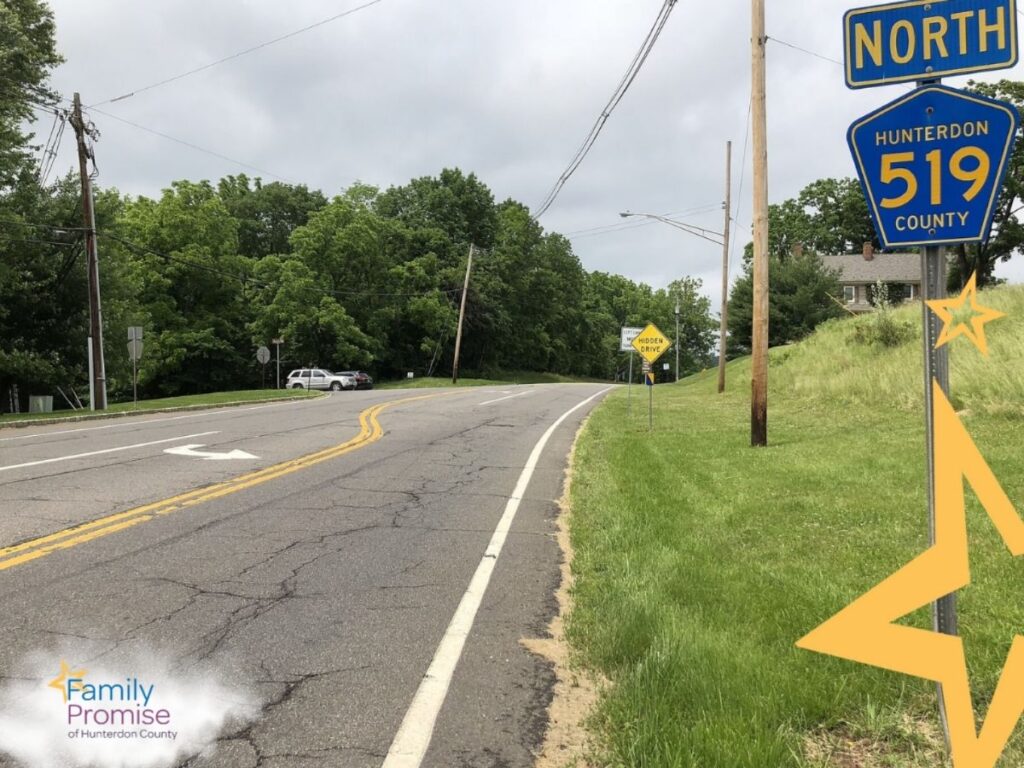
Here in Hunterdon County, transportation can be particularly complicated. While we are so fortunate to live in a county with beautiful open spaces, small communities and a quality of life that attracts people from across New Jersey… these are the very characteristics that make Hunterdon special while also creating transportation challenges.
Hunterdon is geographically large and relatively dispersed. The county encompasses approximately 428 square miles, with a population density of about 301 people per square mile, according to the U.S. Census Bureau. That is very different from a densely populated urban community where a person may be able to walk a few blocks to a grocery store, bus stop, workplace, school or social-service agency.
In Hunterdon, essential destinations can be miles apart. A person may live in one municipality, work in another, have a child in school somewhere else, see a healthcare provider in Flemington and need to access social services in yet another location. For someone with a reliable vehicle, those distances may barely register. For someone without one, the geography changes everything.
A County Where the Car Matters
The numbers help tell the story. According to the U.S. Census Bureau, Hunterdon County workers have an average commute of approximately 33 minutes each way. Housing planning data for the county also illustrate how heavily Hunterdon’s workforce depends on automobiles. In Hunterdon County, approximately 83.5% of workers traveled to work by car, truck or van, according to commuting data cited in a 2025 Hunterdon County municipal housing plan. Approximately 77.7% drove alone, while only 2.9% used public transportation. All of this is suggesting something rather important… Hunterdon’s economy and daily life are structured around mobility by car.
For the majority of residents, that system works. But what happens when someone cannot afford a car? Or their car breaks down? Or they have lost their driver’s license? Or they are a single parent who needs to coordinate work and childcare? Or they have a disability? Or they have recently experienced homelessness and do not have the savings necessary to purchase, insure and maintain a vehicle?
Suddenly, the county’s geography becomes a barrier.
“There Is Transportation” Doesn’t Always Mean “Transportation Is Accessible”
Hunterdon County does have public transportation. The LINK Hunterdon County Transportation System serves all of Hunterdon’s municipalities. Its fixed-route “Shuffle” services operate Monday through Friday, with routes generally running between approximately 6:30 a.m. and 7:30 p.m., although hours vary by route and Saturday service is limited. For municipalities not served by the Shuffle routes, LINK also provides demand-response transportation. That service is curb-to-curb, operates Monday through Friday from 7 a.m. to 5 p.m., is shared rather than private, and generally requires advance scheduling. These services are valuable… they matter… and they are part of the solution.
But availability is not the same thing as accessibility. A transportation system can exist while still leaving gaps for people whose lives don’t fit neatly into its schedules and routes. What if your work shift starts at 6 a.m.? What if you work evenings? What if your job is in another county? What if you need to make several stops in one day? What if you need to get two children to different places? What if your employer changes your schedule? What if you are offered a job but cannot guarantee that you can get there every day? What if the appointment you need is outside Hunterdon County? What if your ride falls through at the last minute?
These are not theoretical questions. They are the kinds of logistical realities that can determine whether a person can maintain employment, access services or remain housed.
Hunterdon County Recognizes Transportation as a Community Health Issue
This isn’t simply Family Promise of Hunterdon County making an observation about our community. Our county’s own public health planning recognizes transportation as an issue. The 2025 Community Health Needs Assessment and 2026–2028 Community Health Improvement Plan, developed through a partnership involving Hunterdon County, Hunterdon Health and local organizations, identified transportation limitations, social isolation and health equity as priority health issues requiring focused and collaborative action over the next three years. The county specifically notes that Hunterdon experiences challenges typical of rural communities despite being frequently recognized as one of New Jersey’s healthiest counties. This is significant because it means transportation isn’t simply an inconvenience affecting a handful of residents. It is being recognized as a factor that intersects with health, equity, access and quality of life… and those same issues intersect directly with housing stability.
Housing and Transportation Are Connected
This story to be continued… stay tuned… sign up for our newsletter at tinyurl.com/HunterdonNews to stay informed.
- Become a monthly supporter
- Donate A Car!
- Sign up for our newsletter: tinyurl.com/HunterdonNews
Together, we can help families overcome crisis and move forward with dignity, hope, and the support they deserve.
by Dawn Hartfelder – updated 8/28/2026